





Kipling Williams
- Media Contact
- SPN Mentor
My interests lie broadly in group processes and social influence. My specific research topics include ostracism, social loafing and social compensation, stealing thunder, Internet research, and psychology and law.
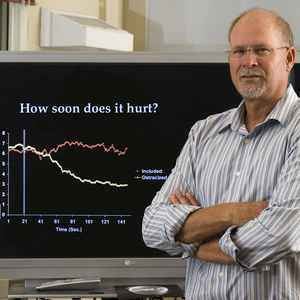
OSTRACISM: I work primarily on ostracism--being ignored and excluded--and how it affects individuals and groups. Our studies indicate that the initial reaction to ostracism is pain, which is similarly felt by all individuals regardless of personality or social/situational factors. Ostracism then instigates actions aimed at recovering thwarted needs of belonging, self-esteem, control, and meaningful existence. Our thinking is that control and existence-fortification can lead to anti-social behaviors, belonging and self-esteem-fortification often leads to social attentiveness and pro-social behaviors. However, a possible dysfunctional consequence of enhancing one's inclusionary status is heightened social susceptibility. We are currently investigating the effects of ostracism on social susceptibility, pro-social behaviors, and aggression. I am pleased to provide you complimentary one-time access to my Annual Reviews article as a PDF file (see link below), for your own personal use. Any further/multiple distribution, publication, or commercial usage of this copyrighted material would require submission of a permission request addressed to the Annual Reviews Permissions Department, email permissions@AnnualReviews.org.
I authored a book on ostracism:
Williams, K. D. (2001). Ostracism: The power of silence. New York: Guilford Publications. You can purchase this on Amazon.com.
I have co-edited three books on ostracism:
Rudert, S. C, Greifeneder, R., & Williams, K. D. (Eds.) (2019). Ostracism, exclusion, and rejection. London: Routledge Press.
Williams, K. D., & Nida, S. A. (Eds.) (2017). Ostracism, exclusion, and rejection. New York: Psychology Press.
Williams, K. D., Forgas, J. P., & von Hippel, W. (Eds). (2005). The social outcast: Ostracism, social exclusion, rejection, and bullying. NY: Psychology Press.
CYBERBALL. I have a free downloadable program called "Cyberball" that can be used in research on ostracism, social exclusion, rejection, bullying, discrimination, etc. We are happy to announce a new improved version of Cyberball (Cyberball 5.0). This upgrade was funded by NSF award 1339160. John Downing is the programmer, and we encourage researchers to give this a try and give us feedback as to how it is working for you. Here are the details:
You can find it at this link: http://www.empirisoft.com/cyberball.aspx
I would like to thank Blair Jarvis, of Empirisoft, for graciously maintaining the server for Cyberball 5, free of charge. Without his contribution, we would be unable to provide Cyberball, free of charge, to interested researchers. Please check out all that Emprisoft has to offer! http://www.empirisoft.com
Follow the instructions provided at this link to download the Cyberball configuration application, the Windows desktop version of the Cyberball game, and the manual. The online version of the game does not need to be downloaded or installed.
Some of its new features include:
1. Up to 9 player games
2. Simple user interface to create any custom schedules with custom throws and custom in-game messages, etc.
3. The custom messages may be a method for manipulating self-disclosure. You can also manipulate the game’s overall welcome message.
4. Stand-alone mode, integration with Qualtrics or integration with MediaLab.
5. Custom player colors/player images/and game background
6. Ability to simulate conversation between players.
7. Game can be run on Windows in a desktop environment or completely online.
8. Online version no longer requires researcher to have their own web server.
9. The same configuration file can be used on the Windows desktop version and in the online version. This configuration file can also easily be shared with colleagues.
10. The configuration application and the web version of the game now auto-update making it easy for researchers to access the latest version of Cyberball.
A manual covering these new features and more can be downloaded at:
http://www.empirisoft.com/cyberball.aspx
Please feel free to email John directly with questions or feedback—or to report a bug.
downing@empirisoft.com
*****************************************
CYBERMALL META-ANALYSIS
A meta-analysis of 120 Cyberball experiments is now published. The abstract reads:
We examined 120 Cyberball studies (N = 11,869) to determine the effect size of ostracism and conditions under which the effect may be reversed, eliminated, or small. Our analyses showed that (1) the average ostracism effect is large (d > |1.4|) and (2) generalizes across structural aspects (number of players, ostracism duration, number of tosses, type of needs scale), sampling aspects (gender, age, country), and types of dependent measure (interpersonal, intrapersonal, fundamental needs). Further, we test Williams’s (2009) proposition that the immediate impact of ostracism is resistant to moderation, but that moderation is more likely to be observed in delayed measures. Our findings suggest that (3) both first and last measures are susceptible to moderation and (4) time passed since being ostracized does not predict effect sizes of the last measure. Thus, support for this proposition is tenuous and we suggest modifications to the temporal need-threat model of ostracism.
The citation is:
Hartgerink, C. H. J., van Beest, I., Wicherts, J. M., & Williams, K. D. (2015). The ordinal effects of ostracism: A meta-analysis of 120 Cyberball studies. PloSONE, 10. e0127002. doi: 10.1371/journal.pone.0127002
Here is the link: http://www.plosone.org/article/fetchObject.action?uri=info:doi/10.1371/journal.pone.0127002&representation=PDF
To see a current list of all published articles using Cyberball, go here: http://www1.psych.purdue.edu/~willia55/Announce/Cyberball_Articles.htm
*****************************************
OSTRACISM ONLINE. My colleagues and I have developed a new paradigm with which to examine the impact of ostracism. This new paradigm is a social media (FaceBook-like) platform, that is freely available to researchers. It's URL is http://smpo.github.io/socialmedia/
Wolf, W., Levordashka, A., Ruff, J., Kraaijeveld, S., & Williams, K. D. (in press). Ostracism Online: A social media ostracism paradigm. Behavioral Research Methods.
*****************************************
REJECT (film). There is a film documentary that just came called REJECT. It was directed and produced by New York director Ruth Thomas-Suh. This is her first documentary.
This film features several social psychologists: me and our lab's work at Purdue, Ethan Kross and his work at the University of Michigan, Naomi Eisenberger and Matt Lieberman and their brain science at UCLA, Nathan DeWall and his work at the Univ of Kentucky, and Ronald Rohner and his life's work on acceptance and rejection at UConn. It very much promotes psychological science as a way to discover and inform public policy on the effects of ostracism, rejection, and exclusion, particularly in our schools.
http://rejectfilm.com
*****************************************
SOCIAL PAIN. Ostracism, like betrayal, humiliation, and interpersonal loss, causes pain. Recent researchers and theorists have argued compellingly that social pain built upon the neural architecture of physical pain, which evolved first. We are currently examining important differences between social and physical pain. One such difference is that social pain can be re-lived over and over again, causing pain on each remembered instance. Physical pain can be recalled as being painful, but is not painful to relive. Four experiments demonstrate this difference in a recent Psychological Science article, "When Hurt Won't Heal: Exploring the Capacity to Relive Social and Physical Pain" (Chen, Williams, Fitness, & Newton, 2008).
*****************************************
SYDNEY SYMPOSIUM OF SOCIAL PSYCHOLOGY. I frequently co-convened (with Joseph Forgas, Bill von Hippel, and others) the annual Sydney Symposium of Social Psychology series (www.sydneysymposium.unsw.edu.au). The last few that I was involved in include the 2004 Symposium on "The Social Outcast: Ostracism, Social Exclusion, Rejection, and Bullying" (with Joe Forgas and Bill von Hippel) and the 2009 Symposium "Social Conflict and Aggression" (with Joe Forgas and Arie Kruglanski). I enthusiastically support this symposium and urge you all to participate if you get a chance.
http://www.sydneysymposium.unsw.edu.au/
http://www.psych.purdue.edu/~kip/Announce/SSSP2004.htm
*****************************************
PSYCHOLOGY AND LAW. I have a long-standing interest in psychological processes that occur before, during, and after a trial. In addition to teaching psych & law, I have testified numerous times as an eyewitness expert, and more recently on ostracism in the workplace. I have examined prejudicial judge's instructions, eyewitness accuracy and confidence, stealing thunder-a social influence tactic, and most recently, the ability of mock-jurors to discount obvious confidence inflation when an eyewitness's in trial confidence far exceeds their initial identification confidence. See our recent article, "'I had a confidence epiphany!': Obstacles to combating post-identification confidence inflation" (Jones, Williams, & Brewer, N.; Law & Human Behavior, 2008).
*****************************************
SOCIAL INFLUENCE
I have published several articles over the years on various forms of social influence, including influence caused by ostracism and stealing thunder.
I am a co-editor on a recent Handbook of Social Influence:
Harkins, S. G., Williams, K. D., & Burger, J. (2017). Oxford handbook of social influence. New York: Oxford Press.
EDITOR OF SOCIAL INFLUENCE
Consider submitting your social influence experiments to SOCIAL INFLUENCE. Article length must be 5000 words or fewer, we like behavioral measures, and we strive to get you an editorial decision within 3 weeks. SOCIAL INFLUENCE covers the range of social influence: psychology, political psychology, consumer psychology, communication science, sociology, and related disciplines.
Primary Interests:
- Aggression, Conflict, Peace
- Close Relationships
- Group Processes
- Intergroup Relations
- Internet and Virtual Psychology
- Interpersonal Processes
- Law and Public Policy
- Persuasion, Social Influence
Research Group or Laboratory:
Online Studies:
Note from the Network: The holder of this profile has certified having all necessary rights, licenses, and authorization to post the files listed below. Visitors are welcome to copy or use any files for noncommercial or journalistic purposes provided they credit the profile holder and cite this page as the source.
Image Gallery


Video Gallery

On Ostracism (Social PsyClips)
Select video to watch
-
13:32 On Ostracism (Social PsyClips)
Length: 13:32
-
1:40 The Origins of Research on Social Rejection and Ostracism
Length: 1:40
-
9:55 On Being an Expert Witness and Trial Strategy
Length: 9:55
-
1:19:09 The Silent Treatment: A Weapon of Mass Destruction
Length: 1:19:09
-
13:00 Social Ostracism
Length: 13:00
-
23:28 Social Ostracism and Rejection for the Incarcerated
Length: 23:28
Books:
- Brewer, N., & Williams, K. D. (Eds.). (2007). Psychology and law: An empirical perspective. New York: Guilford Press.
- Forgas, J. P., & Williams, K. D. (Eds.). (2001). Social influence: Direct and indirect processes. New York: Psychology Press.
- Forgas, J. P., & Williams, K. D. (Eds.). (2002). The social self: Cognitive, interpersonal, and intergroup perspectives. New York: Psychology Press.
- Forgas, J. P., Kruglanski, A. W., & Williams, K. D. (Eds.). (2011). The psychology of social conflict and aggression. New York: Psychology Press.
- Forgas, J. P., Williams, K. D., & Laham, S. M. (Eds.). (2005). Social motivation: Conscious and unconscious processes. Cambridge: Cambridge University Press.
- Forgas, J. P., Williams, K. D., & von Hippel, W. (Eds.). (2003). Social judgments: Implicit and explicit processes. Cambridge: Cambridge University Press.
- Forgas, J. P., Williams, K. D., & Wheeleer, L. (Eds.). (2001). The social mind: Cognitive and motivational aspects of interpersonal behavior. Cambridge: Cambridge University Press.
- Harkins, S. G., Williams, K. D., & Burger, J. M. (Eds.). (2017). The Oxford handbook of social influence. New York: Oxford University Press.
- Rudert, S. C, Greifeneder, R., & Williams, K. D. (Eds.). (2019). Current directions in ostracism, social exclusion, and rejection research. London: Routledge.
- Williams, K. D. (2001). Ostracism: The power of silence. New York: Guilford Publications.
- Williams, K. D., & Nida, S. A. (Eds.). (2017). Ostracism, exclusion, and rejection. New York: Routledge.
- Williams, K. D., Forgas, J. P., & von Hippel, W. (Eds.). (2005). The social outcast: Ostracism, social exclusion, rejection, and bullying. New York: Psychology Press.
Journal Articles:
- Chen, Z., Williams, K. D., Fitness, J., & Newton, N. (2008). When hurt will not heal: Exploring the capacity to relive social and physical pain. Psychological Science, 19, 789-795.
- Eisenberger, N. I., Lieberman, M. D., & Williams, K. D. (2003). Does rejection hurt? An fMRI study of social exclusion. Science, 302, 290-292.
- Gonsalkorale, K., & Williams, K. D. (2007). The KKK won't let me play: Ostracism even by a despised outgroup hurts. European Journal of Social Psychology, 37, 1176-1186.
- Goodwin, S. A., Williams, K. D., & Carter-Sowell, A. R. (2010). The psychological sting of stigma: The costs of attributing ostracism to racism. Journal of Experimental Social Psychology, 46, 612-618.
- Hartgerink, C. H. J., van Beest, I., Wicherts, J. M., & Williams, K. D. (2015). The ordinal effects of ostracism: A meta-analysis of 120 Cyberball studies. PloSONE, 10. e0127002. doi: 10.1371/journal.pone.0127002.
- Hawes, D. J., Zadro, L., Fink, E., Richardson, R., O’Moore, K., Griffiths, B., Dadds, M. R., & Williams, K. D. (2012). The effects of peer ostracism on children’s cognitive processes. European Journal of Developmental Psychology, 9, 599-613.
- Jamieson, J., Harkins, S. G., & Williams, K. D. (2010). Need threat can motivate performance after ostracism. Personality and Social Psychology Bulletin, 36, 690-702.
- Nezlek, J., B., Wesselmann, E., Wheeler, L., & Williams, K. D. (2012). Ostracism in everyday life. Group Dynamics, 16, 91-94.
- Riva, P., Montali, L., Wirth, J. H., Curioni, S., & Williams, K. D. (2017). Chronic social exclusion and evidence for the resignation stage: An empirical investigation. Journal of Social and Personal Relationships, 34(4), 541-564.
- Riva, P., Wirth, J. H., & Williams, K. D. (2011). The consequences of pain: The social and physical pain overlap on psychological responses. European Journal of Social Psychology, 41, 681-687.
- Saylor, C. F., Williams, K. D., Nida, S. A., McKenna, M., Twomey, K., & Macias, M. M. (2013). Ostracism in pediatric populations: Review of theory and research. Journal of Developmental and Behavioral Pediatrics, 34, 279-287.
- Schaafsma, J., & Williams, K. D. (2012). Exclusion, intergroup hostility, and religious fundamentalism. Journal of Experimental Social Psychology, 48(4), 829-837.
- Van Beest, I., Williams, K. D., & van Dijk, E. (2011). Cyberbomb: Effects of being ostracized from a death game. Group Processes and Intergroup Relations, 14, 581-596.
- Wesselmann, E. D., Bagg, D., & Williams, K. D. (2009). "I feel your pain”: The effects of observing ostracism on the ostracism detection system. Journal of Experimental Social Psychology, 45, 1308-1311.
- Wesselmann, E. D., Cardoso, F., Slater, S., & Williams, K. D. (2012). “To be looked at as though air”: Civil attention matters. Psychological Science, 23, 166-168.
- Williams, K. D. (2011). The pain of exclusion. Scientific American Mind, January/February, 30-37.
Other Publications:
Courses Taught:
- Classics in Social Psychology
- Elementary Psychology
- Graduate Seminar in Social Influence
- Introduction to Social Psychology
- Psychology and Law
- Social Psychology and Film
Kipling Williams
Department of Psychological Sciences
Purdue University
703 Third Street
West Lafayette, Indiana 47907-2081
United States of America
- Phone: (765) 494-0845
- Fax: (765) 496-1264
